Mission Manifest

Cornell University Press, 2024.

United States in the World Series

Publisher pageAmazon page

Photographic Essay

Shannon discusses the book:

Cairo Review podcast pt. 1 / pt. 2

Page 99 blog

Cornell Authors in Conversation podcast

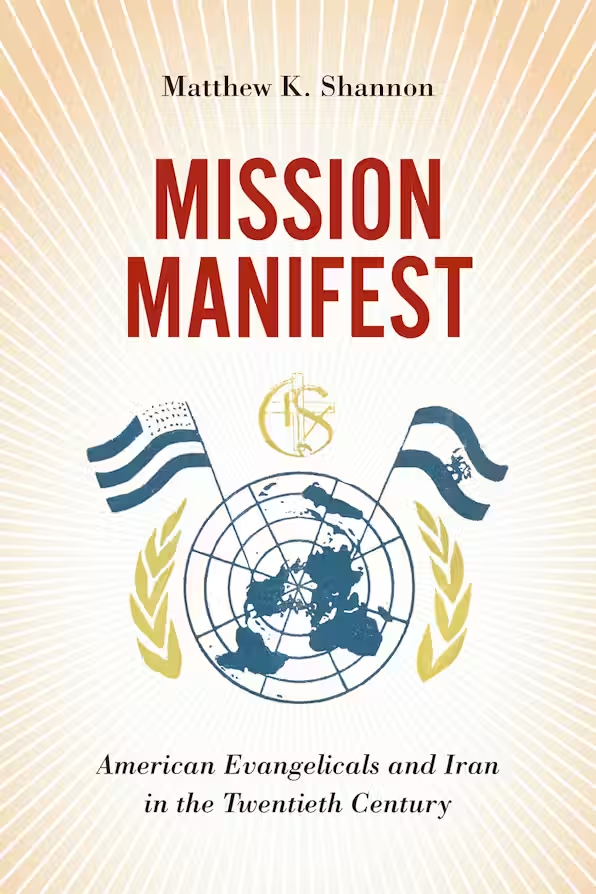
In Mission Manifest, Matthew Shannon argues that American evangelicals were central to American-Iranian relations during the decades leading up to the 1979 revolution. These Presbyterian missionaries and other Americans with ideals worked with US government officials, nongovernmental organizations, and their Iranian counterparts as cultural and political brokers—the living sinews of a binational relationship during the Second World War and early Cold War.
As US global hegemony peaked between the 1940s and the 1960s, the religious authority of the Presbyterian Mission merged with the material power of the American state to infuse US foreign relations with the messianic ideals of Christian evangelicalism. In Tehran, the missions of American evangelicals became manifest in the realms of religion, development programs, international education, and cultural associations. Americans who lived in Iran also returned to the United States to inform the growth of the national security state, higher education, and evangelical culture. The literal and figurative missions of American evangelicals in late Pahlavi Iran had consequences for the binational relationship, the global evangelical movement, and individual Americans and Iranians.
Mission Manifest offers a history of living, breathing people who shared personal, professional, and political aims in Iran at the height of American global power.
What are reviewers saying?

Mark Edwards in Diplomatic History: “Shannon accomplish[es] his most important goal of intertwining histories of religions and of the United States in the World. Mission Manifest is a fitting tribute to the ‘religious turn.’ It also charts new pathways for how to write religions into and around the study of US foreign relations. Shannon proves that our longstanding sacred-secular binary says more about our own limitations as researchers and storytellers than it does about our subjects’ lives and passions.”

Anna Hager in the American Historical Review: “As much as this book is a contribution to the thriving field of western missions to the Middle East, this book offers a valuable addition to the study of US-Iranian relations under the Pahlavi monarchy….Mission Manifest is a fascinating book and a welcome addition to the history of western missions, but it also gives a different perspective on US-Iranian relations and its religious and ideological underpinnings.”

Heather Sharkey in Iranian Studies: “Shannon succeeds in appealing to multiple constituencies: scholars interested in the history of the United States and its global engagements in the Cold War era, as well as those interested in US-Iranian relations and in Christian missions as they evolved in the postcolonial period into development-oriented and largely nonsectarian (secular) nongovernmental organizations….Shannon’s fine book testifies to the influence and appeal of American soft power, as well as to the intimate but vexed relationship that has prevailed between Iran and the United States.”

Philip Hopkins in the Middle East Journal: “There is much to admire about Shannon’s work. He presents his argument in a measured, exegetical manner, allowing the research to speak for itself and letting his conclusions emerge organically….Shannon’s work on a lesser-known facet of American-Iranian relations is written well and investigated meticulously. Mission Manifest is a welcome addition to the field of Iranian Studies.”

Sam Mehraban Rahmani in the Journal of Religious History: “The book’s primary strength lies in its practical, evidence-based analysis….The writing is accessible yet scholarly, making the book suitable for both academic and general audiences. Shannon’s ability to weave together personal stories of missionaries and Iranians with broader historical trends creates a compelling and engaging narrative….Shannon’s balanced approach and nuanced analysis make Mission Manifest an essential read for anyone interested in the history of US-Iranian relations and the global impact of evangelical Christianity.”

Andrew Chalfoun in Reading Religion: “Shannon has given us a carefully crafted description of Presbyterian activity in 20th-century Iran. Mission Manifest joins a growing body of scholarship that seeks to disentangle the complex and often contradictory relationships between American missionaries and other agents of US hegemony.”

Ian Van Dyke in the Journal of Presbyterian History: “Mission Manifest brings a new level of sophistication to a rapidly maturing subfield at the intersection of religious history and the study of US foreign relations….As a case study of US-Iran relations, Mission Manifest’s thematic structure allows readers to dissect the complexity of international power, interreligious and intercultural communication, and the dynamics of interpersonal relationships….[T]his book marks an important contribution to religious and transnational history, and a model from which future historians will surely benefit.”

Alan Eyre in the Foreign Service Journal: “Matthew Shannon’s Mission Manifest gives the fuller ‘origin story’ behind American involvement in Iran and is essential reading not just for those interested in Presbyterian missionary history in Iran but also for all interested in the complete story of U.S.-Iran relations.”