Losing Hearts and Minds

Cornell University Press, 2017.

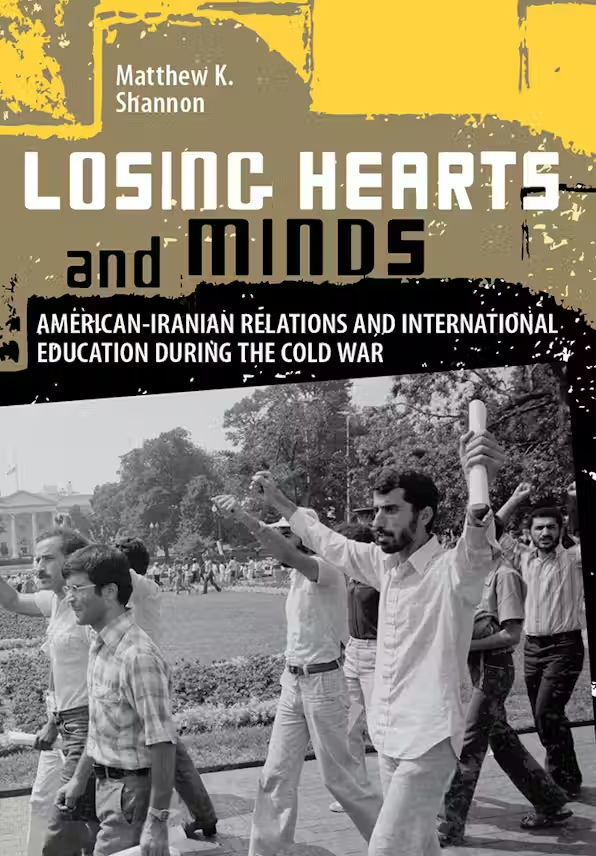
Matthew K. Shannon provides readers with a reminder of a brief and congenial phase of the relationship between the United States and Iran. In Losing Hearts and Minds, Shannon tells the story of an influx of Iranian students to American college campuses between 1950 and 1979 that globalized U.S. institutions of higher education and produced alliances between Iranian youths and progressive Americans.
Losing Hearts and Minds is a narrative rife with historical ironies. Because of its superpower competition with the USSR, the U.S. government worked with nongovernmental organizations to create the means for Iranians to train and study in the United States. The stated goal of this initiative was to establish a cultural foundation for the official relationship and to provide Shah Mohammad Reza Pahlavi with educated elites to administer an ambitious program of socioeconomic development. Despite these goals, Shannon locates the incubation of at least one possible version of the Iranian Revolution on American college campuses, which provided a space for a large and vocal community of dissident Iranian students to organize against the Pahlavi regime and earn the support of empathetic Americans. Together they rejected the Shah’s authoritarian model of development and called for civil and political rights in Iran, giving unwitting support to the rise of the Islamic Republic of Iran.
Praise for Losing Hearts and Minds

Nathan Citino in Diplomatic History: “Shannon describes a clash not of civilizations but between the Shah’s authoritarianism and the students’ transnational organizing for democratic principles. In Shannon’s story, Americans and Iranians appear on both sides of the conflict over whether to compel the Shah to respect human rights…. Shannon has written one of the finest available monographs on students as transnational actors. His book is also required reading for anyone wishing to comprehend the full story of U.S. relations with Pahlavi Iran.”

Roham Alvandi for H-Diplo: “Matthew Shannon’s Losing Hearts and Minds is a welcome addition to a new wave of work on the United States’ relationship with Iranian the decades of the 1960s and 1970s…. Shannon has challenged historians of US-Iran relations to think beyond diplomatic history and consider the transnational….Shannon’s work has broadened our gaze beyond diplomats, soldiers, and spies, in order to consider the significance of activists, students, and technocrats, amongst others, in shaping the relationship between Iran and the United States…. This is a long-overdue development that will no doubt influence the future trajectory of the historiography.”

Mary Ann Heiss in the Journal of American History: “Matthew K. Shannon’s creatively conceived, deeply researched, and tightly argued study of the experiences of Iranian students in the United States during the 1960s and 1970s offers a host of fresh insights into both the bilateral U.S.-Iran relationship and the fall of the Pahlavi Dynasty…. Along the way, it connects key ideas such as the increasing role of human rights for U.S. foreign policy…and international student activism and the global youth movement. Both a strong self-contained case study and part of a much larger, transnational narrative, it deserves a wide readership.”

Osamah Khalil in the American Historical Review: “Shannon’s work deserves praise for his impressive archival research, broad scope, and focus on students as transnational actors….Shannon also deserves credit for disputing notions about the roots of the Iranian revolution….Losing Hearts and Minds is an important addition to the literature on U.S.-Iranian relations. It is well crafted and accessible for undergraduate and graduate courses. Its focus on transnational actors during the Cold War will inspire and inform future studies.”

Talya Zemach-Bersin in the History of Education Quarterly: “In Losing Hearts and Minds, historian Matthew K. Shannon offers a case study of tremendous import for those seeking to advance our understanding of international education beyond a comprehension of policy goals and lofty educational ideals…. In telling this fascinating and troubling transnational history, Shannon illustrates to diplomatic historians how much can be gained by attending seriously to the political significance of education.”

Ray Takeyh in Survival: “Shannon belongs to a new generation of historians who seek not merely to illuminate state-to-state relations but to shed light on other actors who played important roles.”